Your Travel Guide to Thailand
All information & tips to prepare your trip in Thailand
Transport in Cambodia
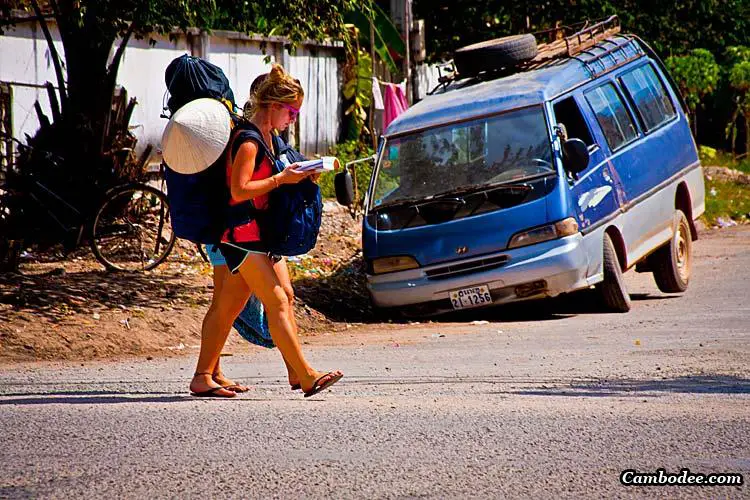
Getting around Cambodia
Cambodia is easy to travel around by public transport. The road network has improved a lot in recent years, notably with the expressway between Phnom Penh and Sihanoukville, and most journeys between tourist towns are made by bus or minibus, at low prices. The train is running again on two lines, boats serve the islands and, in some seasons, link Phnom Penh, Siem Reap and Battambang via the Tonle Sap. To save time, a domestic flight connects Phnom Penh and Siem Reap.
In town, the tuk-tuk is the most common means of transport, and the Grab and PassApp apps let you book one at a fixed price in the big cities. Book your tickets a few days ahead in high season (November to February) and during holidays (Khmer New Year in mid-April, Pchum Ben in September or October, the Water Festival in November).
Search for a transport ticket in Cambodia
Enter your departure city, your arrival city and your departure date.
How to get to Cambodia?
Warning: the land border between Thailand and Cambodia has been closed since June 2025, and no reopening date has been announced. Buses from Bangkok to Siem Reap and Bangkok to Phnom Penh no longer run.
- By plane from Thailand: the simplest option. Allow about 1 h 15 of flight from Bangkok to Siem Reap (new Siem Reap – Angkor airport, SAI, about 50 km from town) or to Phnom Penh (new Techo airport, KTI). Several airlines fly the route every day from Suvarnabhumi and Don Mueang.
- From Europe or North America: no direct flights, but good connections via Bangkok, Singapore, Doha, Dubai or Ho Chi Minh City.
- Overland from Vietnam: the Moc Bai – Bavet crossing is open. Direct buses link Ho Chi Minh City to Phnom Penh in 6 to 7 hours, formalities included. There is also a boat service on the Mekong between Chau Doc and Phnom Penh.
- Overland from Laos: the Nong Nok Khiene – Trapeang Kriel crossing links southern Laos (Pakse, the 4,000 Islands) to Stung Treng, then Kratie, Phnom Penh or Siem Reap.
Means of transport in Cambodia
Bus and minibus
This is the most widely used means of transport. The big companies (Giant Ibis, Larryta Express, Mekong Express, Virak Buntham…) link all the tourist towns with air-conditioned buses, often with Wi-Fi and a bottle of water, and night buses with berths on long journeys. Minibuses (vans) are faster but more cramped, with little room for luggage. Allow about $10 to $15 for Phnom Penh – Siem Reap. Tickets can be booked online: you compare times, companies and travellers’ reviews, and receive an e-ticket.
Book a bus ticketTrain
The Royal Railway company runs two passenger lines from Phnom Penh: the southern line to Takeo, Kampot and Sihanoukville, and the northern line to Pursat and Battambang. Travellers’ favourite route is Phnom Penh – Kampot: one train a day in each direction, leaving Phnom Penh around 7 am and arriving in Kampot around 10:40 am, for about $9. The train is slower than the bus over long distances, but it is a very pleasant way to cross the countryside, quietly, with plenty of legroom.
Tickets are not sold by platforms such as 12Go: buy them on the official Royal Railway website or at the station. Seats are numbered and sell out fast; sales open about a week before departure. Timetables change from time to time and delays are frequent: check them before you go and don’t connect with a flight on the same day.
Book a train ticket on the official Royal Railway websiteBoat
Fast ferries link Sihanoukville to the islands of Koh Rong and Koh Rong Samloem in 45 minutes to 1 hour, several times a day. Between Phnom Penh and Siem Reap, a boat crosses Tonle Sap lake in 7 to 8 hours during the high-water season (roughly June to November); a lovely experience, but more expensive and longer than the bus. Between Siem Reap and Battambang, the boat trip up the Sangker River is one of the most beautiful journeys in the country, when the water level allows. Finally, speedboats link Phnom Penh to Chau Doc, in Vietnam, along the Mekong.
Book a boat ticketPlane
The only really useful domestic flight links Phnom Penh and Siem Reap in 55 minutes, several times a day. Taking into account the journeys to the airports, which are far from the centres, the time saved compared with the bus is small: the plane is mainly worthwhile to connect with an international flight. Siem Reap, Phnom Penh and Sihanoukville have flights to Bangkok and other Asian capitals.
Book a Phnom Penh – Siem Reap flightPrivate taxi and car with driver
For groups, families with children or if you want to stop along the way, a car with driver is very convenient and stays affordable once the cost is shared: allow about $80 to $100 for Phnom Penh – Siem Reap. It can be booked online, through your hotel or with a local agency. Shared taxis are cheaper, but they leave when full and are often overloaded.
Book a private transferScooter and car hire
Scooter rental is common in Kampot, Kep, Battambang, Sihanoukville or Mondulkiri ($5 to $10 a day), but not in Siem Reap, where it is in principle not allowed for foreigners. You need a valid motorbike licence and an international driving permit, and helmets are compulsory: if you have an accident without a licence, your insurance will not cover you. Traffic is chaotic in towns and country roads are sometimes in poor condition: two-wheelers are for experienced riders only. Self-drive car hire is rare and not recommended.
The main routes in Cambodia
Approximate journey times, excluding delays and stops. Click on a route to see the timetables, today’s prices and book your ticket.
| Route | Duration | Transport | Booking |
|---|---|---|---|
| Phnom Penh – Siem Reap | 5 h 30 to 7 h (bus), 55 min (plane) | Bus, minibus, plane, boat (seasonal) | Book |
| Siem Reap – Battambang | 3 to 4 h | Bus, minibus, boat (seasonal) | Book |
| Phnom Penh – Battambang | 5 h (bus), about 7 h (train) | Bus, minibus, train | Book |
| Phnom Penh – Kompong Chhnang | about 2 h | Bus, minibus | Book |
| Phnom Penh – Pursat (Kompong Luong) | 3 h 30 to 4 h | Bus, minibus, train | Book |
| Phnom Penh – Kampot | 3 h (bus), about 3 h 40 (train) | Bus, minibus, train | Book |
| Phnom Penh – Kep | 3 h 30 | Bus, minibus | Book |
| Kampot – Kep | 30 min | Tuk-tuk, minibus | Book |
| Phnom Penh – Sihanoukville | 3 to 4 h (bus), longer by train | Bus, minibus, train | Book |
| Sihanoukville – Koh Rong | 45 min to 1 h | Fast ferry | Book |
| Sihanoukville – Koh Rong Samloem | 45 min to 1 h | Fast ferry | Book |
| Phnom Penh – Kratie | 5 to 6 h | Bus, minibus | Book |
| Phnom Penh – Mondulkiri | about 6 h | Minibus | Book |
| Phnom Penh – Ho Chi Minh City | 6 to 7 h | Bus | Book |
| Bangkok – Siem Reap | 1 h 15 | Plane (land border closed) | Book |
| Bangkok – Phnom Penh | 1 h 20 | Plane (land border closed) | Book |
Getting around Cambodian towns
The tuk-tuk (a carriage pulled by a motorbike) is everywhere. Agree on the price before setting off, or book it with a ride-hailing app: the price is fixed in advance and you don’t need to explain the address. Grab works in Phnom Penh, Siem Reap, Sihanoukville and Kampot; PassApp, the local app, also covers Battambang and Kampong Cham and is paid in cash. Keep small dollar and riel notes.
How to get around Siem Reap
Ride-hailing apps : Grab and PassApp (tuk-tuk, remorque and car)
Central Siem Reap is easy to explore on foot. For everything else, the tuk-tuk is king: book it with Grab or PassApp for a fixed price, with no haggling. For the temples, the most practical option is a tuk-tuk for the day with its driver (small circuit, grand circuit or Banteay Srei, price agreed the day before), or a car with driver for Kulen, Beng Mealea and Koh Ker. Bicycles and e-bikes can be rented everywhere and are allowed in the Angkor park. However, scooter rental to foreigners is in principle not permitted in Siem Reap.
Transport to Siem Reap · Siem Reap and the temples of Angkor
How to get around Phnom Penh
Ride-hailing apps : Grab, PassApp and WowNow (tuk-tuk, remorque and car)
Phnom Penh is spread out and traffic is heavy: most people get around by tuk-tuk or remorque booked through Grab, PassApp or WowNow, at the price shown in the app. Car taxis are ordered the same way. There is a city bus network (less than $1 a ride), but few travellers use it. Always keep your bag and phone on the inside of the vehicle.
How to get around Battambang
Ride-hailing apps : PassApp (no Grab)
The town centre can be explored on foot or by bicycle. For the countryside (Phnom Sampov, Wat Banan, bamboo train), take a tuk-tuk for the day: drivers offer ready-made tours. PassApp works in Battambang, Grab does not.
How to get around Kompong Chhnang
No Grab or equivalent here: tuk-tuk, motorbike taxi or boat, price to be negotiated.
In town and to the pottery villages, people get around by tuk-tuk or motorbike taxi, price to be negotiated. The floating villages are visited by boat from the port, with a boatman.
How to get around Kompong Luong
No Grab or equivalent here: tuk-tuk, motorbike taxi or boat, price to be negotiated.
From Pursat or Krakor, take a tuk-tuk or a motorbike taxi to the landing stage, then a boat with a boatman to explore the village. No Grab here.
Transport to Kompong Luong · Kompong Luong, the floating village
How to get around Kampot
Ride-hailing apps : Grab and PassApp
The town can be explored on foot or by bicycle. For the pepper plantations, Bokor and Kep, rent a scooter (international driving permit required, helmet compulsory) or take a tuk-tuk for the day. Grab and PassApp work in Kampot.
How to get around Kep
No Grab or equivalent here: tuk-tuk, motorbike taxi or boat, price to be negotiated.
Kep stretches along the coast: you need a tuk-tuk (to be negotiated or booked through your hotel) or a rented scooter. Boats to Koh Tonsay leave from the pier next to the crab market.
How to get around Sihanoukville
Ride-hailing apps : Grab and PassApp
Grab and PassApp work well and save you haggling between the bus station, the port and Otres.
How to get around Koh Rong
No Grab or equivalent here: tuk-tuk, motorbike taxi or boat, price to be negotiated.
There are no cars on most of the island: you walk, take a water taxi between beaches or a motorbike taxi on the road linking Koh Touch to Sok San. Bring a head torch for the evenings.
How to get around Koh Rong Samloem
No Grab or equivalent here: tuk-tuk, motorbike taxi or boat, price to be negotiated.
No roads: you get around on foot along the trails or by boat between beaches, often arranged by your accommodation.
How to get around Kratie
No Grab or equivalent here: tuk-tuk, motorbike taxi or boat, price to be negotiated.
Kratie is best explored by bicycle (rented from guesthouses) or by tuk-tuk. For the Kampi dolphins (15 km north), negotiate a return trip by tuk-tuk or motorbike taxi.
How to get around Mondulkiri
No Grab or equivalent here: tuk-tuk, motorbike taxi or boat, price to be negotiated.
In Sen Monorom, people get around by motorbike taxi or rented scooter. For the waterfalls and villages, guesthouses organise trips by 4x4 or motorbike with a driver.
Find your hotel at the best price:
- Find a hotel in Siem Reap
- Find a hotel in Phnom Penh
- Find a hotel in Battambang
- Find a hotel in Kompong Chhnang
- Find a hotel in Pursat
- Find a hotel in Kampot
- Find a hotel in Kep
- Find a hotel in Sihanoukville
- Find a hotel in Koh Rong
- Find a hotel in Koh Rong Samloem
- Find a hotel in Kratie
- Find a hotel in Sen Monorom